Apple lets its products overlap without letting them become interchangeable. The iPhone Duo's hardware says "I can be your iPad in some sense"; iOS says but not fully. Hardware creates possibility, software creates boundaries — and that fence is what stops the lineup from collapsing into one universal device, while leaving you intrigued enough to go buy the main thing anyway.
Apple has always been very good at making one product feel a little too close to another.
The iPad can look suspiciously like a laptop. The MacBook can feel like a giant iPad with a keyboard. And now, with the new iPhone Duo, the iPhone can literally unfold into something that looks an awful lot like an iPad mini.
And I think that's the point.
Apple unveiled the iPhone Duo last night, its first foldable iPhone. Closed, it's a phone. Open it, and you get a 7.6-inch display — large enough to enter very clearly into iPad territory. It even supports Apple Pencil, with that support coming later this year.
That is a fascinating choice. Because Apple has essentially created an iPhone that can do a pretty convincing impression of an iPad.
But it still isn't an iPad. And I think Apple is deliberately very good at keeping it that way.
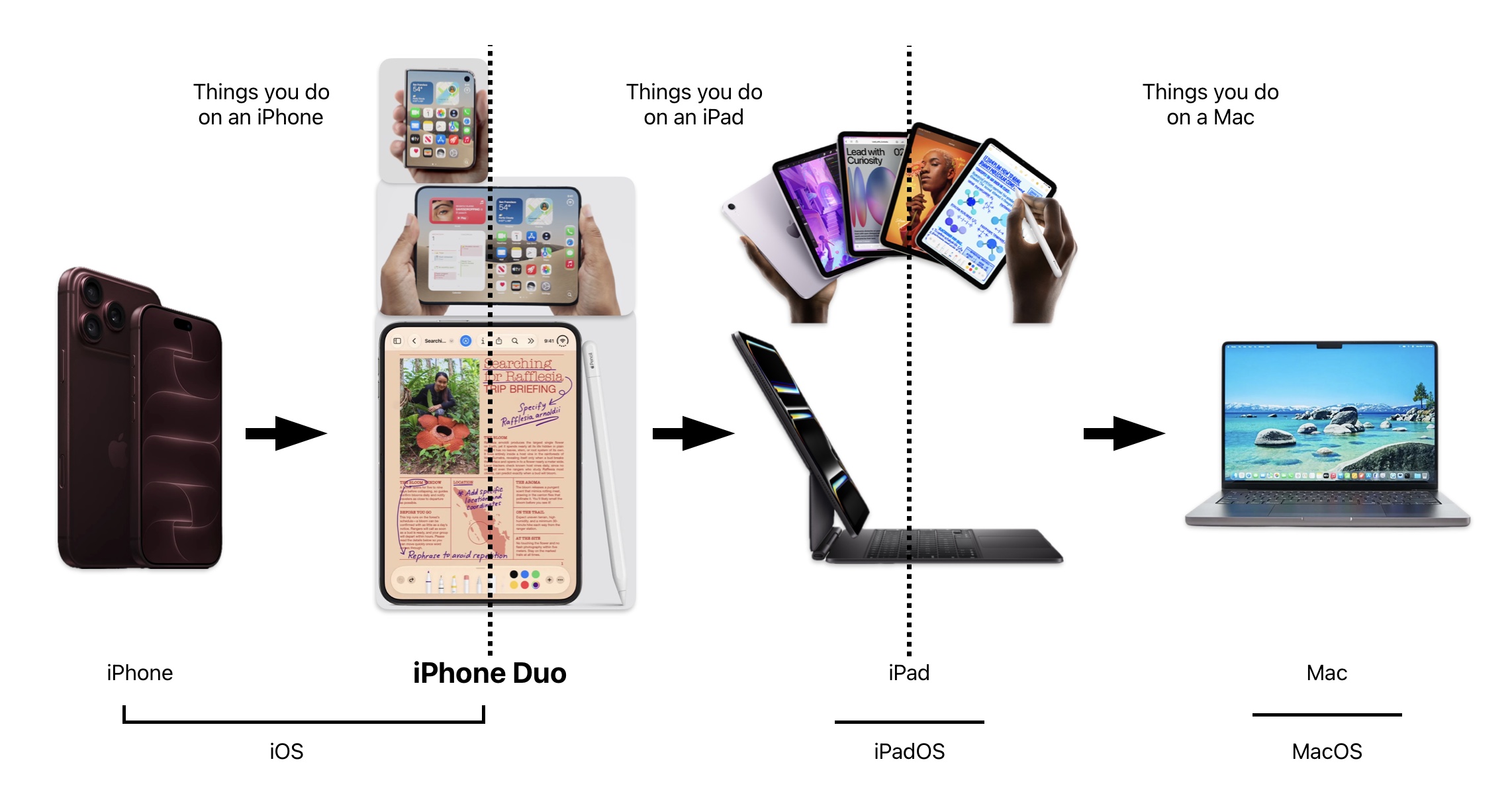
The overlap is in the hardware. The fence is underneath, in the brackets.
Apple likes products that flirt with the next category
Think about the iPad.
For years, Apple has made the iPad increasingly capable of doing things we traditionally associate with computers. It has a keyboard. It has a trackpad. It has desktop-class apps. It can edit video, manage files, connect to external displays and, increasingly, behave like a computer.
At some point you might look at an iPad Pro and think: "Why would I need a Mac?"
Then you use it for a while. And eventually, the differences become obvious.
The iPad is still an iPad. Its operating system, interaction model and software ecosystem establish a boundary that hardware alone doesn't.
The same thing happens in the other direction. A MacBook has a beautiful display, excellent speakers, a trackpad and an increasingly touch-friendly ecosystem. But you still can't reach up and touch it.
They deliberately preserve the distinction.
And now the iPhone Duo does the same thing
The Duo is probably the clearest example yet.
Open it up and you get a 7.6-inch display. Apple says it's the largest display ever put into an iPhone, and it supports iPad-like multitasking and, later this year, Apple Pencil.
That's basically a miniature iPad experience. But it is still an iPhone running iOS 27, and it isn't running iPadOS.
That's the invisible line. And it's an incredibly important one.
The hardware says: "I can be your iPad in some sense." The software says: "But not fully."
That distinction is what prevents Apple's product lineup from collapsing into one universal device.
The brilliance is not in making one product do everything
I think there's a tendency to look at Apple's product strategy and assume the goal is convergence. One day, perhaps, your iPhone will become your iPad. Your iPad will become your Mac. And your Mac will become… whatever comes next.
But Apple seems to be doing something slightly different. It allows products to overlap without allowing them to become interchangeable.
That's a much more interesting strategy.
Your iPhone Duo can become an iPad-like device when you're sitting at an airport and want a bigger screen. Your iPad can become a laptop-like device when you attach a keyboard. But when you actually have access to the adjacent product, you still have a reason to choose it.
That's the key.
The "when my main thing feels overkill" principle
I think this is where Apple is particularly clever.
The adjacent capability isn't necessarily designed to replace the adjacent product. It's designed to save you when that product isn't available.
Don't want to carry your MacBook? Your iPad can handle a surprising amount of work. Don't want to carry your iPad? Your Duo can give you a much bigger screen with Pencil support.
It's convenience, not substitution.
And that distinction matters. Apple isn't necessarily asking "can this device replace the other one?" It's asking: "can this device become good enough at the other thing when you don't want to bother bringing the main thing along?"
That's a much easier proposition.
The operating system as the fence
This is probably my favourite part of Apple's strategy.
Hardware creates possibility. Software creates boundaries.
The Duo's physical form makes it possible to have an iPad-like canvas in your pocket. Apple Pencil makes the comparison even stronger. But iOS keeps the product identity intact.
The iPad has iPadOS — Apple being very strategic and clever to separate iPadOS from iOS back in 2019. The Mac has macOS. The iPhone has iOS.
The hardware can flirt with the neighbouring category all it wants. The operating system reminds you where you actually are. And Apple can keep increasing the overlap without necessarily destroying the reason to buy the other product.
Apple doesn't need perfect product separation
In fact, I think the opposite is true. Apple benefits from making the boundaries fuzzy enough to be useful, but clear enough to preserve the lineup.
That's why the Duo can look like an iPad mini without killing the iPad mini. Why an iPad can look like a MacBook without killing the Mac.
They're constantly flirting with each other. But they never quite become one another.
And that's probably intentional. The overlap is what makes you wonder — you get intrigued enough to think "if I can already do this much with this thing, the real thing must be a better experience." So you go and try the main thing.
That's another sale in their bag, and they deserve one.
The check: if this is the strategy rather than a step towards convergence, two things should hold. The Duo's Pencil support, when it ships later this year, will be a limited iOS-flavoured version of what an iPad does with a Pencil — not iPadOS handwriting brought over wholesale. And the iPad mini will still be in the lineup a year from now. If the mini quietly disappears after the Duo ships, the flirtation was substitution all along, and I had this wrong.